

You put a strip on before bed, feel it lift the sides of your nose, and find it on the pillow a few hours later. Or one end keeps peeling up, so you spend more time pressing it back down than forgetting it is there.
If your nasal strips keep falling off, start with the skin underneath, the position and the fit. Buying a different strip is one option, but first it helps to work out what is happening. This guide takes you through a practical evening routine, the mistakes worth checking and how to remove your strip comfortably in the morning.
Quick answer: If nasal strips keep falling off, apply a fresh strip to clean, completely dry skin without cream underneath. Follow the placement guide and press both ends securely; OMNIAIR recommends 10–20 seconds. Check the size if the edges cannot sit flat; remove with water and stop using strips if irritation develops.
Why do nasal strips keep falling off?
A nasal strip needs its adhesive ends to stay in contact with your skin. The flexible splint provides the outward lift, while those ends anchor it on either side of your nose.
That makes the contact area worth checking before you decide that the strip itself is the problem. Moisture, skincare residue, placement and an unsuitable size can each get in the way of a comfortable application.
Notice when it starts lifting
An edge that never sits flat gives you a different starting point from a strip that feels secure for several hours. Look at what you can actually observe: where it lifts, whether the skin was dry, and whether the strip felt awkward from the start.
These observations are clues, not a way to diagnose an adhesive fault from one night. They make it easier to decide what to adjust next and what to tell customer support if it keeps happening.
Washing is only part of preparation
Clean skin still needs to dry completely. Putting a strip on immediately after washing, while the sides of your nose remain damp, misses that second step.
The principle is consistent across different products: Breathe Right's instructions identify wet, oily and moisturized skin as unsuitable for adhesion, while Intake also instructs users to clean and fully dry the nose. Their products differ, so follow your own strip's positioning instructions. Breathe Right application FAQ and Intake application guide.
How should you apply a nasal strip before bed?
Prepare in front of a mirror, with enough light to see both ends. Keep the packet nearby so you can check the diagram without trying to hold an exposed strip at the same time.
1. Wash your hands and the nose area
Use your usual gentle cleanser and water to remove surface dirt and skincare residue, then rinse. Clean the sides of the nose as well as the centre, since the strip needs contact there too.
There is no need to scrub hard or make your skin feel tight. If cleansing leaves the area sore, do not add adhesive over it.
2. Let the skin dry fully
Pat the area dry with a clean towel and check the creases beside your nose. If you have just showered or finished training, wait until you are dry and no longer actively sweating before applying.
Do not wet a breathing strip to activate it. These are adhesive nasal strips, not the pore-cleansing strips used in some skincare routines.
3. Check the position before peeling
Use the placement diagram supplied with your strips. A conventional nasal strip spans the nose, with its ends sitting on the sides above the nostril flare rather than high up near the eyes.
Do not copy the placement of a magnetic system with separate tabs. Its components and fitting method are different from a single strip with a flexible splint.
4. Handle the adhesive as little as possible
Remove the backing carefully and avoid touching the sticky contact areas. Aim to position the strip once, rather than repeatedly lifting it to make small cosmetic adjustments.
If you are unsure where it belongs, practise locating the position with the backing still on. Once you expose the adhesive, keep it away from the sink, towel and countertop.
5. Press across both ends
OMNIAIR's current instructions recommend pressing down for 10–20 seconds on clean, fully dry skin. Give both adhesive ends attention instead of pressing only the centre. OMNIAIR Daily strip instructions.
Then look in the mirror. The ends should lie against the skin without a folded corner, and the strip should feel comfortable rather than painfully tight.
Can you use nasal strips with moisturiser or skincare?
You do not have to abandon your whole evening routine. The useful distinction is between skincare elsewhere on your face and product directly underneath the strip.
OMNIAIR specifies no moisturiser or sunscreen on the application area. Letting a cream absorb does not necessarily leave the same surface as freshly cleaned skin, so do not use a waiting time as a guarantee that it will stick.
Keep the contact area clear
Work around the area where the adhesive ends will sit, and avoid spreading cream onto their edges after application. Remember that your fingers may still have product on them when you open the packet.
If your nose needs a prescribed topical treatment, follow that treatment's instructions and ask your clinician or pharmacist about combining it with an adhesive strip. Do not skip prescribed care just to improve hold.
Should you use an alcohol wipe?
Alcohol wipes appear frequently in online troubleshooting discussions, but they are not part of the OMNIAIR preparation instructions checked for this guide. Start with those instructions rather than adding a stronger cleansing step from a forum.
Do not substitute household cleaning wipes, lens-cleaning products or an adhesive booster. If ordinary preparation does not work for your skin, contact the brand for suitable next steps instead of escalating the products you apply to your nose.
Does strip size matter more than stronger adhesive?
Size and adhesive answer different questions. Adhesive needs to hold; the strip also needs to sit where its ends can make comfortable contact.
If a strip appears too wide, bunches at the sides or has corners you cannot lay flat, check the fit. Stronger hold does not correct a shape that sits awkwardly on your nose.
When to consider a smaller strip
OMNIAIR's Small version is a narrower option for people who find the Daily strip too wide. Compare the fit with the supplied instructions rather than choosing a size based only on age, gender or a product photograph. OMNIAIR Small nasal strips.
A strip coming off once is not proof that you need Small. Check preparation and position first; if the width still looks wrong, ask for sizing help before ordering another full supply.
Do not cut the strip to reshape it
Use an appropriately sized product instead of trimming its ends or cutting through the splint. Breathe Right explicitly warns that cutting its strips compromises their function; it is not a useful general workaround for a fit problem. Breathe Right sizing guidance.
Do not add household glue or stack tape over the strip to force it to stay down. The goal is a comfortable application you can also remove as directed.
What about black versus transparent?
Choose a finish you like, but do not assume that colour alone predicts how well a strip will stay on your skin. Construction can differ between versions and brands, and an individual customer's experience is not a controlled comparison.
When asking for help, name the exact product, including Daily, Small or Sport and its finish. That is more useful than asking for whichever colour is supposedly strongest.
What should you check if it still comes off?
Use this table to narrow down the next sensible step. It is a troubleshooting aid, not a guarantee that one visible sign has only one cause.
| What happens | What to check | What to try next |
|---|---|---|
| It will not stick when first applied | Damp skin, cream underneath or touched adhesive | Start with properly prepared skin and a fresh strip |
| One corner lifts immediately | A fold, uneven placement or an awkward fit | Check the diagram and whether both ends can lie flat |
| It holds initially, then comes off overnight | Sweat, rubbing and anything contacting the strip | Note when it happens and review the evening routine |
| The same side lifts repeatedly | Placement on that side and contact with bedding or a mask | Look for a repeatable pattern; ask support if it continues |
| It feels too wide even when correctly placed | The size relative to your nose | Compare with the Small option or request fitting help |
| It stays on but leaves painful skin | Removal method or a reaction to contact | Stop use on the affected area and seek advice if symptoms persist |
Check contact with other items
If you wear a sleep mask, check whether its lower edge presses against the strip when you lie down. Avoid solving that by overtightening the mask or moving the strip away from its intended position.
If you use a prescribed breathing device, do not alter its fit or treatment to accommodate a strip. Ask your care team about compatibility if the two interfere with each other.
Give support something specific to work with
If several fresh strips fail despite following the instructions, send the product name, order details and any batch information on the pack. A clear photo of placement can help if your skin is comfortable enough to apply one.
Explain whether the strip lifts straight away or later, and whether this started with a new pack. You should not need to keep buying replacements without getting help identifying a possible fit, handling or product issue.
How do you remove nasal strips without pulling your skin?
Removal is part of the routine, especially when you are trying to improve overnight hold. OMNIAIR's instructions say to use water, peel slowly and never remove the strip dry.
Wet the strip and surrounding skin, then ease it off gradually. If it still tugs, stop and wet it further rather than pulling harder; take your time around each end.
Do not scrape at any residue with your fingernails. Gently wash the area and check how your skin feels before considering another application.
Stop using strips if you develop irritation, and do not apply over sore, broken or already irritated skin. If a reaction is significant or does not settle, ask a healthcare professional for advice; a product described as hypoallergenic is not a promise that nobody can react.
Which OMNIAIR strip fits your evening routine?
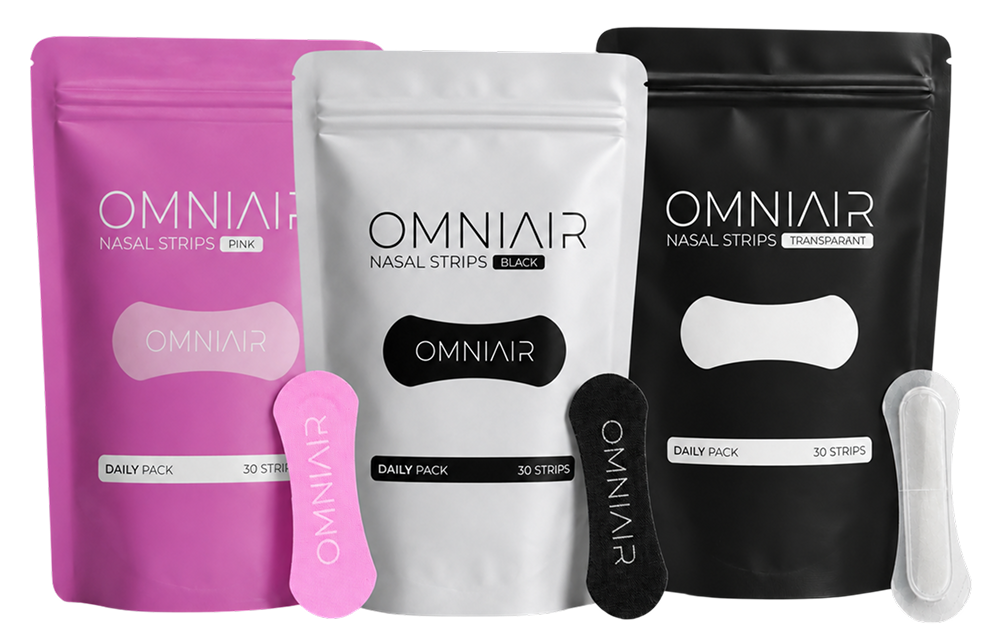
The Daily Black nasal strips come in a matte satin finish, with 30 single-use strips per pack. The current base price is €21.99, and the listed wear time is up to 8–12 hours; follow the instructions on your own pack.
If the standard shape feels too wide, the Small range offers a narrower fit. Choose on that basis rather than assuming you need a training product because one evening's strip came loose.
You can browse the Daily nasal strip collection to compare finishes. For the separate question of how these products work, read the science behind nasal strips.
A comfortable fit and a repeatable application routine are useful starting points. They do not make a strip a treatment for an underlying breathing condition or a replacement for prescribed care.
Frequently asked questions
Why do my nasal strips keep falling off even after washing?
The skin may still be damp, there may be skincare residue, or the position or size may need checking. Dry the area completely, use a fresh strip and check that both ends can sit flat.
How long should I press an OMNIAIR nasal strip down?
OMNIAIR recommends 10–20 seconds. Press both ends against clean, fully dry skin rather than holding only the centre of the strip.
Can I put a nasal strip over moisturiser?
OMNIAIR recommends keeping moisturiser and sunscreen off the application area. Keep that patch of skin clean and dry; follow professional advice if you need prescribed topical treatment there.
Can I reuse a nasal strip that has fallen off?
OMNIAIR nasal strips are single-use. Do not wash and reuse one or try to restore its adhesive; check your skin and preparation before using a fresh strip.
Should I cut a nasal strip if it feels too big?
Choose a suitable size instead. Cutting can interfere with the product's structure and intended fit; OMNIAIR offers a Small version for narrower noses.
Should I wet my nose before applying a nasal strip?
No. Apply to fully dry skin. Water belongs in the removal step for OMNIAIR strips, not the application step.
What if the strip hurts when I remove it?
Stop pulling, wet it further and remove slowly. Discontinue use if irritation occurs, and seek professional advice for a significant or persistent reaction.
Find your fit in the OMNIAIR Daily nasal strip collection.
Ready to upgrade your recovery?
Science-backed tools, built for athletes who take recovery seriously.
Shop OMNIAIR